#27 SEAT-OF-THE-PANTS SHAMANISM: The Dead Ride into the Sunset
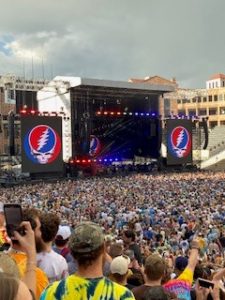
Dead & Co. stage at Folsom Field in Boulder, CO, July 1st, 2023. (Pics by Diane Levine)
“When we get onstage, what we really want to happen is, we want to be transformed from ordinary players into extraordinary ones, like forces of a larger consciousness. And the audience wants to be transformed from whatever ordinary reality they may be in to something a little wider, something that enlarges them. So maybe it’s that notion of transformation, a seat-of-the-pants shamanism, that has something to do with why the Grateful Dead…keeps the audience coming back and what keeps it fascinating for us, too.”
–Jerry Garcia
You hit a certain age and more and more people start to die from the world. Bulwarks of a sense of society and culture unavoidably shift and disappear. Someone like Tina Turner showing up in the death notices did that to me the other day. Turner and Janis Joplin, the most important and electrifying women singers of 60s rock, left their mark. Turner managed to continue her career for decades and pass away retired in Switzerland at 83. Joplin didn’t make it past 1970.
“Pigpen” McKernan, the Grateful Dead’s original keyboardist and one of its dynamic singers, didn’t make it farther than 1973, the first officially dead member of the Dead. But when Jerry Garcia, their lead guitarist, lead singer, and one of their main song writers, died in bed smiling in 1995, I figured that was it for them. His sound defined the band more than any other player’s, and he played in his own nearly inimitable, indelible style.
Thus I accepted that this experience, aesthetically and spiritually formative for me and, to this day, something I cannot compare to other concert, theater, or screen experiences, had concluded. That’s the thing about death: its finality.
But it was not quite as final as all of that. Various remaining members pulled together in various combinations, but the most successful form they found has been Dead and Company, on “The Final Tour” and visiting Folsom Field in Boulder this weekend where I caught what will certainly be my last full on Dead experience.
Only two members of the original band remain in it: Bob Weir, lead singer and rhythm guitarist, and Mickey Hart, percussionist. (The other long-time drummer, Bill Kreutzmann, for not entirely clear reasons, did not join the tour, replaced by Jay Lane.) Nevertheless, they still manage to generate the Dead sound and experience in, to me, an authentic, recognizable, living way…and I’ve often wondered how to convey what that is to someone who’s never experienced it, or, for that matter, someone who has but didn’t get it.
That’s the thing. If you get what’s so great about it, a gate has opened into virtually another world of possibility. If you don’t, I don’t think I can explain it to you.
But I’m a writer, so I’m constitutionally inclined to try.
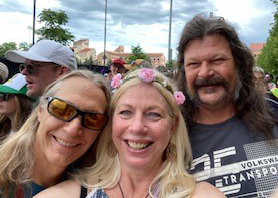
Old Deadheads: Gary, Diane, & Neil
I’ve long thought that a tribal, shamanic description of a Dead concert was not so far off. It starts with the tribe gathering at the sacred grounds of the venue. Suddenly everyone’s tricked out in their most colorful clothing. People stream in in a joyful mood. Outside there’s “Shakedown Street,” the continuously re-arising Dead marketplace (which, irritatingly, Folsom Field here in Boulder seems to be repressing over the last two years) where you can buy your coconut milk and weed pipes carved into Jerry’s visage. People playing instruments spontaneously gather, and old friends meet old friends with an effortless kismet.
Nowadays the Dead crowd has grown old enough to regularly fill a football stadium with three generations, which has become an even more familial vibe. A lady elderly enough to need a wheelchair got rolled through the ticket line as we stood in it. But it’s the young people that hearten me, looking a lot like we used to look when I started doing this back in the 70s, trailing their long hair, full of beauty, humor, and enthusiasm. They get it.
The show itself consists of longtime Dead tunes they either wrote or cover, with little variation, especially once Garcia dissolved into aether. It has a fundamental structure, which they don’t vary from, inclined toward shorter songs for the first set (though willing to throw themselves impulsively into longish jams and occasional, improvised segues), while the second set features more short songs, eventually they flow together, including inevitably the “drums/space” section (more on that below), on their way through a major ballad, a high energy finish, and an encore (nowadays they do only one).
That’s the structure, though the songs change from night to night and come out of a huge cache they accumulated over the decades. Deadheads like to look for something unusual, unexpected, and maybe in this concert it was, at least for me, “Dear Mr. Fantasy,” an old, classic Traffic song I’d never heard live.
Dear Mister Fantasy, play us a tune
Something to make us all happy
Do anything, take us out of this gloom
And I think—sans angst-ridden metal—that’s often what we want from a concert. The first waves of magic, though, come through hearing either a favorite song you might be hoping for, but especially any song where the band latches onto it and flies down the road with it. That happened on the second tune, “Truckin’,” one of their most famous old warhorses, where Weir punched out the vocals and the guitar took off, riding higher and higher crests from the band.
In the absence of Garcia, John Mayer, once a kind of popstar in his own right, has nailed down Garcia’s style, something he plays with a delighted zeal. My ear cannot discern between him and Garcia, though my friend Jeff says his can. Jeff plays guitar, and I don’t, but what remains outstanding in Garcia’s style is the sensitivity and suppleness brought to the strings and the seemingly limitless ways of bending the notes. I can’t think of anyone who took the electric rock guitar down these roads (Hendrix, of course, could have if he tried). Richard Thompson’s subtle, precise feel comes to mind, and not much else.
The Dead draw from an enormous number of influences: 50s rock, what became classic rock, blues, rhythm & blues, soul, funk, reggae, country & western, bluegrass, old folk songs, and…jazz. Back when rock songs weren’t over three minutes long, the Grateful Dead covered whole sides of a record (20 minutes) with a single jam, and they were certainly listening to late period John Coltrane and the like back in those days, soloing like there was no tomorrow, pushing into crazier and more unidentifiable areas of sound. Jazz, in the end, may be the most decisive influence as it encouraged them to improvise without necessarily a clear plan of arrival, bringing us round again to the shamanism theme.
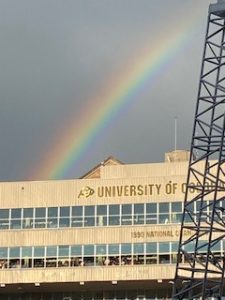
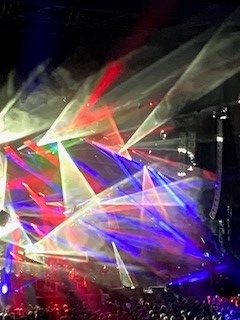
Rainbows accompanied the first set.
Since there’s at least potential opportunity in most of their songs to take off and explore, sometimes in a quiet, pretty, delicate way (not so much in this concert), or in an excited, more aggressive mode, or simply chugging along, seeing where it’ll take you, there’s a sense of getting on the train with them and riding the rails. I’ve been to many concerts over the decades, and sometimes they’re simply sharper and more inventive than at others, something the crowd can collectively know and feel. That symbiosis with the crowd—what any good performer seeks to generate—becomes more exhilarating as band and crowd invent the experience together.
So the band becomes the shamans conducting the ritual, and the fans, dressed in their ritual costumes, dance and sing their way into the ecstatic space, chanting their liturgies and sadhanas, carried wherever the band is willing and able to take them. Which does bring us to the drugs, the sacraments of our ritual.
That sacrament could merely be beer. It’s most often marijuana (you can smell all kinds fragrantly wafting this way and that in an outdoor arena, or going down the row and back hand to hand), a now semi-acceptable psychedelic. At the same time, you have to give credit to LSD and the like for pushing the envelope. Would the Grateful Dead have become the Grateful Dead we know without those things? It’s like asking if Playboy would have become Playboy without naked women in it. Probably not.
We could discuss here the value, dangers, therapeutic effects, side effects, and so on of these kinds of drugs. Certainly there have been any number of casualties this way (and with beer, too!). But crucial would be mind and perception getting pushed into vivid, open space. This is what I don’t think–with or without drugs—exists in other large scale aesthetic experiences. That sense of space that the music fills, defines, fades into, comes out of, that threads through whatever they play, becomes its own force as the concert unfolds.
At the same time, a lot of the roots music and the old time America evoked in many of Robert Hunter’s lyrics give their shows an every man (or woman) (&LGBTQetc.) grounding in the gain and loss, hope and fear of daily lived life.
They say it takes a lot to win, and even more to lose.
You and me we gotta spend some time wonderin’ what to choose.
Bob Dylan in his book The Philosophy of Modern Song, treats each song he’s commenting on like a distillation of an emotional state, telling the gist of a story that takes up a few pages of prose as he retells it. That’s the sense in each story they sing in concert; we connect to some essential kind of human experience that gets felt and processed, and their songs might dwell on love and loss like most pop songs, but then (these are all from the concert I saw) they’ll do a gritty blues rendition of “Smokestack Lightning,” a train of longing and loss howling away into the night, or playing poker as a metaphor for taking chances in your life (“Deal”—killer rendition), or a miner complaining to his girlfriend on his way to work a coal mine (“Cumberland Blues”), someone on the lam ducking the law (“Don’t Ease Me In”), or trying to find some vibrancy in your seemingly nowhere town (“Shakedown Street”). This includes several outlaw songs they like to do, like the honed classic they did here, “Me and My Uncle,” which concludes:
Love my uncle, God rest his soul
Taught me good, Lord, taught me all I know
Taught me so well, that I grabbed that gold
I left his dead ass there by the side of the road
They also do anthems visionary of human goodness and unity (“Terrapin Station”) or human spiritual beauty (“Eyes of the World”), or adventures into purely psychedelic domains (“St. Stephen”—my first—and last—time to hear it live).
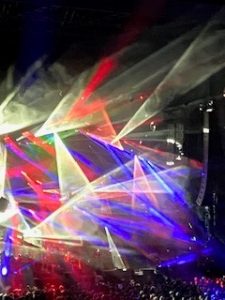
Space & light.
In this way, you take your own tour of the world and states of consciousness, familiar ones, and the ones that the band always finds their way into as they meld into “drums/space.” It’s hard to emphasize how unusual it is for a band to take the attention off itself as it plays. Whatever song structure they were exploring (“Cumberland Blues” on this night) gets taken apart and reconstructed.
The forward motion of the song evaporates until it becomes something else completely. The brilliant, creative lighting that wonderfully gives visual dimension to the music, lets the stage go dark and returns the attention to the total space of the arena, flashing and freely playing about it. The band melts from focus, and you enter mind/space at large. Here the percussion takes over, and this could go any number of angles and directions, quite unlike the bravura solo performances of most rock drummers. There’s exultation in pure sound and the fantastical possibilities of using your amplifiers to stretch and twist it and stretch it again in some other way in the giant arena space.
The band carries its listeners through this adventure, eventually picking up again into a conventional song structure, as all the instruments find their way back to cohesion. I can’t express how wonderful the interplay between them gets as the concert unfolds, weaving in and out of one another. Of course, the guitars have to layer this way, but Oteil Burbridge’s bass deserves notice for its nimble inventiveness, and on this night, Jeff Chimenti’s keyboards asserted themselves with many playful, energized runs. According to the set list I found on line (because honestly I don’t remember it clearly), they fell into a rousing climax of “Sugar Magnolia” with a segue into “Scarlet Begonias” (two odes to charming women), returning to the outro of Sugar Mag (something I do remember clearly that I didn’t see coming) for the finish, and the old standard, “Going Down the Road” as encore.
And there it was—the last remaining hippie band of sixties still doing it, still producing its magic, and taking us somewhere we simply wouldn’t go without them. That’s the sacred space you visit at a Dead concert in a way that you can’t find elsewhere. They have their lineage in the jam band scene, and their greatest inheritor band, Phish, but there is something that brought that elderly lady back to it in her wheelchair, something that captivates young people to this day. I’m grateful (pun or no pun) for getting a last dance in this mandala that does indeed enlarge me, harmonize me with others, and open up my perception. It’s been a kind of singular gift, this experience, but as important to me and so many as this has been, I can’t really explain it to you.
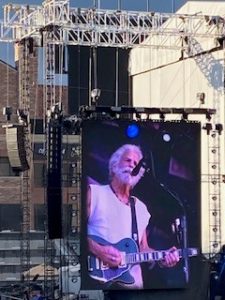
Bob Weir, still standing.
Beautiful. Some other friends of mine posted pics there too. Thanks for providing such a tangible flavor!
Yeah, Gary, very nicely transmitted– the whole begonia.
Nice review Gary. I enjoyed it, as well as the concert. I went on Sunday night. And thanks for the honorable mention.
Having health issue bonanza this summer.. Surgery last Fri, more tomorrow, unrelated issued, same torso. Your review was closest I could be there, feel it. Wicked fomo had amid the 3 night stint. Thanks for the write up, could nearly smell the beer, weed, patchouli crowd scent trifecta!. Glad you went down the rabbit hole one last trip
Great Gary! Probably the best description of the Good Old Grateful Dead experience I have read. I remember being at a GD concert in 1970 or 71 at the Fillmore East, where Bill Graham lowered a banner during the concert that said “There is nothing like a Grateful Dead Concert.” That’s the truth…