
BLOG #55 A MINOR POEM BY ALLEN GINSBERG
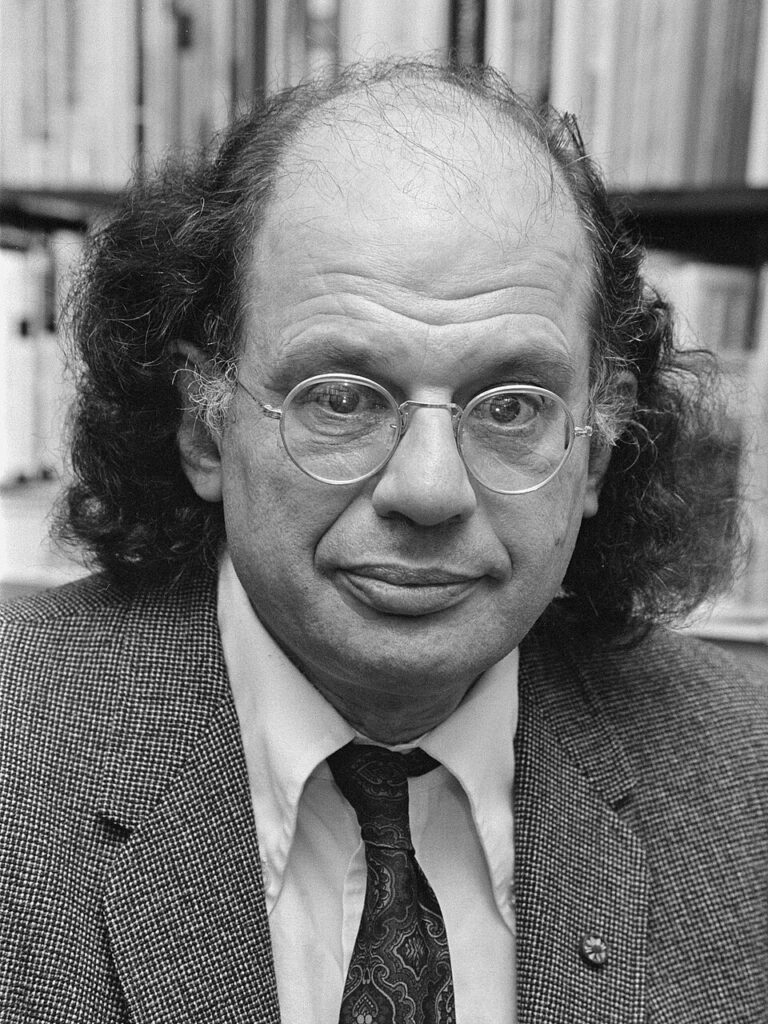
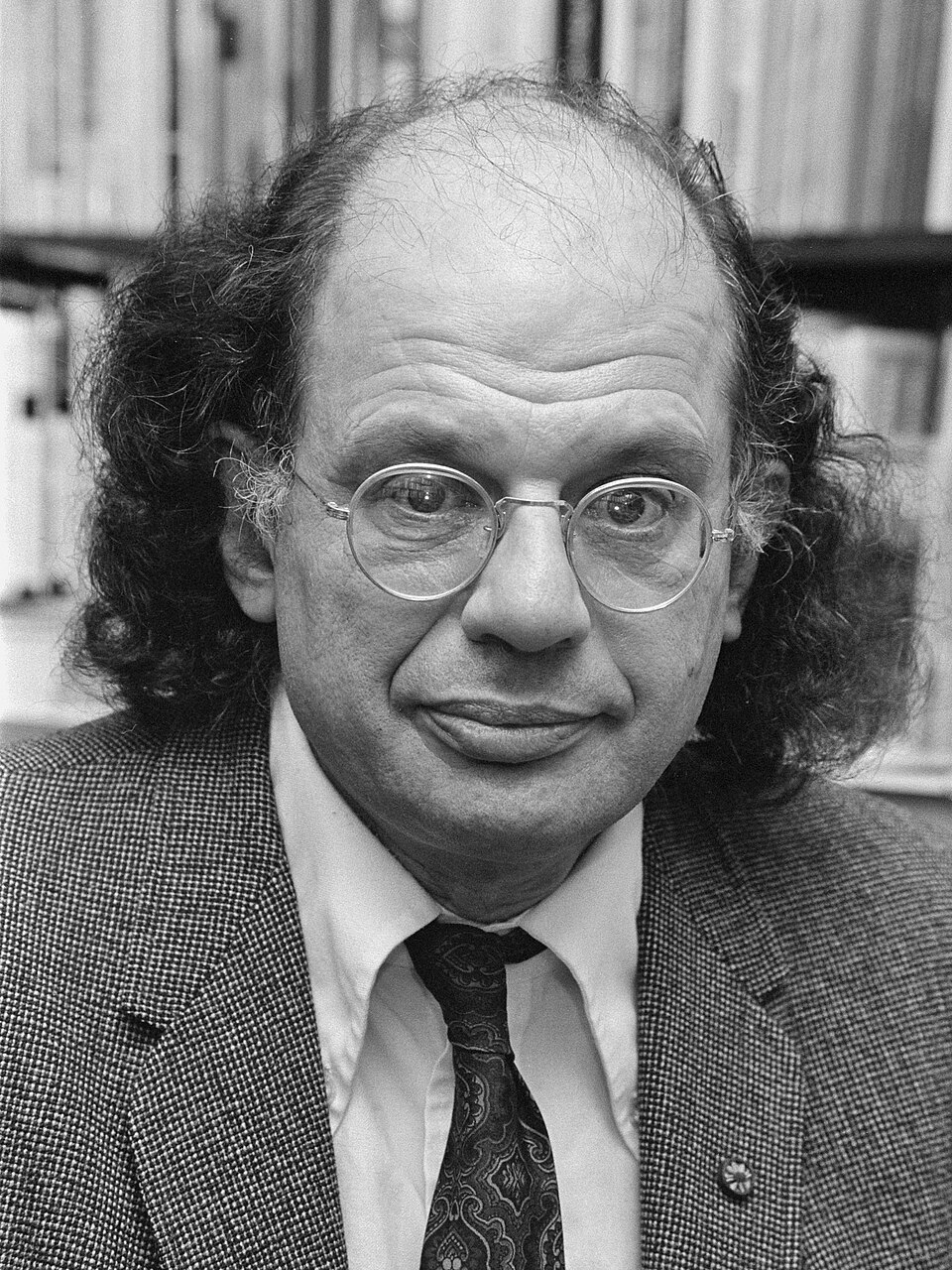
Allen Ginsberg circa 1979
It’s been a hundred years since Allen Ginsberg’s birth (1926-1997) in New Jersey. I worked as one of his secretaries in the 1980s. A principle task I had was to type his hand-written journals, including his poems. I particularly liked at the time “Eroica,” and later told him that (published in Plutonian Ode, 1982). He replied that Lawrence Ferlenghetti also said he liked “Eroica,” but Allen personally regarded it as a “minor poem.”
Well, is this a major or minor poem, regardless of Allen’s opinion? To me, that’s not exactly the right question. It’s the kind of poem that comes with a poet’s maturation and ease with his art, understanding, and vision.
Immediately we get the elegant setting:
White marble pillars in the Rector’s courtyard
at the end of a marble-white street in the walled city of Dubrovnik—
That’s Dubrovnik, Croatia, still a medieval city on a hill overlooking the Adriatic (used as the location shot of King’s Landing, for Game of Thrones fans out there). But quickly we’re brought into a sense of time that’s not purely the immediate evening with the local symphony orchestra, but the tattered, bloodied fabric of European history:
All the fleet sunk, Empire foundered, Doges all skeletons & Turks vanished to dust
World Wars passed by with cannonfire mustard gas & amphetamine-wired Führers—
Beethoven’s drum roll beats again in the stone household
A number of brutal nightmares brood around the orchestra as it tunes up for Beethoven’s 3rd Symphony, “Eroica,” but we’re brought charmingly back to the immediate present:
Bassoonists press lips to wooden hollow wands,
The Violinists fiddle up and down excitedly—First Violin
with a stubborn beard (at his music stand with a young girl in black evening dress)
waits patiently the orchestra tuning and tweedling to a C—
You get a little of the sound in the wording, such as the bassoons’ “oo’s” and the “o’s,” the “wooden” and the “wands.” Then the orchestra pulls together and begins:
The brasses ring out, trumpets puffing, French horns blaring for Napoleon!
Conductor whips it to a Bam Bam Bamb.
The wording’s rhythms start up the music. Beethoven, smitten with Napoleon’s leadership of the French Revolution and the potential of democracy sweeping Europe, wrote his symphony in an up-welling of inspiration and hope for mankind, dedicating it to the General:
But Beethoven got disgusted with Napoleon & scratched his hero name off the
Dedication page—
Napoleon had declared himself emperor, and what had been a surging aspiration turned to bitterness. The music Beethoven composed to heroism would have to endure without its hero, carrying the heroic load itself. Ginsberg then focuses in on the 2nd movement:
Now the Funeral March! I used to listen to this over the radio in Paterson during the
Spanish Civil War—
At last I know it’s the bassoons Carry the wails of high elegy
at last I see the cellos in their chairs, violinists swaying forward, bassmen standing
looking sad
as all bow together the mournful lament & dead march for Europe,
The end of the liberty of Dubrovnik, the idiot cry March on Moscow!
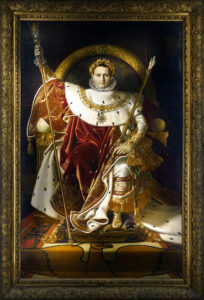
Napoleon Bonaparte, a man with big ideas about himself
We get a little of Allen’s childhood relation to this music against the backdrop of yet another sad Xxth Century European nightmare. It’s almost as if Beethoven has anticipated what’s to come, even as he composed a lament to the grief-stricken past. Ginsberg invokes the musicians’ enactment. “ “The end of the liberty” becomes the catastrophic “idiot cry,” and if you’ve watched your government do something senselessly destructive for no good reason other than the leader’s ego, you can feel what this might mean.
Dubrovnik’s musicians take revenge on Napoleon,
by playing Beethoven’s heroic chords in a Castle by the sea at Night—
Electric Globes on wrought iron stands light the year 1980 (Emperor
Napoleon & Emperor Beethoven alike snoring skulls)
The music gallantly sallies forth, binding past and present (“in a Castle by the sea at Night”). The worldly emperor Napoleon gets invoked against the all-world emperor emoter of Beethoven, but both great conquerors find themselves conquered by the transitory nature of things. Both escape as towering figures and both get reduced to no more than “snoring skulls.” The lament proceeds:
The Funeral Fugue Begins! The Death of Kings, the screaming
of Revolutionary multitudes
as the Middle Ages tumble before Industrial Revolution
a Mysterious Clarion! an extended brassy breath!
serene rows of island cities in violin language,
working back and forth from violins to bassoons—
The drum beats the footfalls of Coffin Carriers—
History and the evocation of history in music mesh, and the poetic lines find a way musically to shape the images thereof. The percussion lands in “the footfalls of Coffin Carriers–”
over the roofs the lilt of a sad melody emerges,
like silent cats on red tile, the strings Climb up sadder—
What happens when the artistic gesture captivates you? Maybe it even absorbs into the world around you at that moment, such as the sadness of strings climbing beyond the “red tile” of the rectory where Allen’s listening. It comes from Beethoven’s heart to Allen’s, and his heart to ours…an aspiration stronger than all the human violence, but the violence worsens:
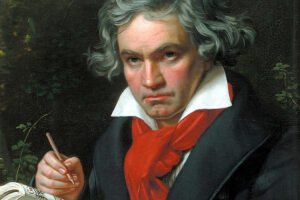
Ludwig van Beethoven, a man with a pen in touch with his feelings
Napoleon has himself crowned Emperor by the Pope!
Unbelievable! Atom Bombs drop on Japan! Hitler attacks Poland! The Allies fire-bomb
Dresden alive! America goes to war—
Now Violins and Horns rise Counterpoint to a thunderous bombing! Kettledrums war up!
Bam Bamb! End of Scherzo!
The sadness ends in war, and in war propagating war, and the symphony thunders to the end of its 3rd movement, launching into the conclusion:
Finale—Tiptoeing thru history, Pizzicato on the Bass Cello & Violins as Time
marches on.
Running thru the veins, the lilt of victory, the Liberation of man from the State!
It’s a big dance, a festival, every instrument joined in the Yea Saying!
We arrive at heroic victory, not of subjugating antipathetic peoples, but of subjugation itself, the wild possibility of final justice in the class oppression campaigns that go back well farther than the Turks. Internal rhyme and assonance–”Pizzicato on the Bass Cello & Violins as Time marches on”–puts the music in the words. The freedom to dance at last, and dancing has commenced! If you feel it as it happens, if the artist brings you into it fully enough, you might start believing it to be true, with “every instrument joined in the Yea Saying.”
…. Off we go on one ear, then another,
Titanic Footsteps over Middle Europe—
And a waltz to quiet down the joy, But the big dance will come back like Eternity like
God like
a hurricane an Earthquake a Beethoven Creation
a new Europe! A new world of Liberty almost 200 years ago
Prophesied thru brass and catgut, wood bow & breath
Gigantic Heartbeat of Beethoven’s Deaf Longing—
The Prophecy of a Solid happy peaceful Just Europe—
It’s “a new world of Liberty almost 200 years ago.” The music and poetry carries us into this ecstatic envisioning of humankind that’s long gone, partially achieved, and still beckoning all at once. We can feel it moving alive through the artist’s tools: “Prophesied thru brass and catgut, wood bow & breath.” We’re living in and pining for “The Prophesy of a Solid happy peaceful Just Europe–” and by that metaphor, a solid, happy, peaceful planet.
And then out of nowhere we’re brought back suddenly to time and place:
In the middle of a note, an interruption! Cloudburst!
The Conductor wipes his head & runs away,
basses and cellos lift up their woods and vanish into Cloakrooms,
French Horns Violins and Bassoons lift eyes to the shower & scatter under balconies
in the middle of a note, in the middle of a big Satyric Footstep,
The larger world intrudes into this artistic projection, and the very tangible musicians and instruments get chased by rain from the scene. Having spent so much time caught up in the music and its many historical resonances, forward and back, and the deep engagement of the orchestra in emoting Beethoven’s grip on the lightning of epic aspiration, whimsically, charmingly the orchestra breaks apart & goes running every which way from the scene. The poem, the evening, the march of history, all come to an unexpected turn at a very particular moment:
Pouf! Rain pours thru the sky!
Musicians and audience flee the stone floor’d courtyard,
Atrium of the Rector’s House Dubrovnik October 14, 1980, 10:45 P.M.
So: Is this poem great or minor? It’s not going to compete with “Howl” or “Mind Breaths,” I suppose, but I feel now, as I felt while typing this poem out on a typewriter in 1981, carried off into “a Castle by the sea at Night,” as the orchestra lives out the music, spurring vast, aggrieved contemplations that somehow land lightly, with poet’s grace. As dense as this poem is, I’m always taken with its effortlessness by a poet now long at his craft, age 54 in 1980. When the rain comes and breaks up the performance, suddenly something else asserts itself, like vivid sufferings abruptly gone to dust, or like the flash of inspiration that takes things a whole other direction, leaving the past behind.
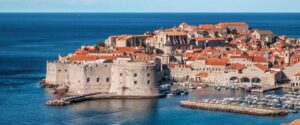
In Dubrovnik, in a Castle by the Sea
[If you want to read the complete text of “Eroica,” go here. Look in the contents under Plutonian Ode, near the end.]
You know the one where the basses have a long break in the 9th symphony, so they decide to go out to a bar, but take the absurd precaution of rigging the score with string so the conductor can’t turn to the page where they start singing? Bottom of the 9th, the score was tied, and the bases were loaded. In Ginsbeg’s poem, it was just a rain delay in the 3rd. Sorry, that was a minor league joke.
With major league build up!
I have difficulty following poems and felt completely enthralled in this with your clear description. Thank you!