
#56 HOW I BEGAN ‘I’LL BEGIN IN THE MIDDLE’
I’ve always been interested in artistic process and accounts of how certain works came to life.
On a furiously windy day a couple years ago in Boulder–I believe it was April–Xcel Energy cut the power to a lot of neighborhoods, no doubt trying to avoid what had happened with the Marshall fire that burned a thousand homes. I went through some misadventures, but found myself at Vicki Jensen’s house, in a neighborhood that still had electricity. It was on prime real estate in Boulder, downtown close to Pearl Street Mall. She explained that she’d decided to sell it, now late in her life, and move to the mountains.
She showed me a lot of old books and things she sought to divest from, and somehow explained that in her youth she’d posed as the model for a famous image used on the dust sleeve of the Door’s album L.A. Woman (1971): a woman crucified on a telephone pole. I looked at her astonished, a little amused, and generally amazed that here we were–the artistic and karmic threads of that led to her living room. Her crucifixion had graced billboards.
But more to the point, I took a few books from her, among them Scratching the Beat Surface (1982) by Michael McClure. It had been around Naropa throughout the 80’s. I’d always wanted to read it and finally had a copy. It’s McClure’s foray into articulating his poetics–which I’ll define here as a poet’s sense of vision and the practicalities of form that express that. You can get quite technical about how and why you think a poem should do what it does. McClure invokes his influences (Shelley, Blake, Pound, Duncan, Olson etc.) and contemporaries (Ginsberg, Whalen, Kerouac), while giving accounts of some early compositions, and to some extent, how he came to write in his characteristic style down the middle of the page, erupting into all capitals, putting in empty spaces, to capture the physical, biological process, as he saw it, of rendering his consciousness.
I read it with interest, and went back to his September Blackberries (1974), to further re-engage with his poems. All of which brought me to a moment a few months after the windstorm, when I sat down at my keyboard, said, “What the fuck,” and started writing a poem down the middle the page, putting things in all caps:
I’LL BEGIN IN THE MIDDLE
of the sentence? The place between poles?
IN THE CENTER
where it’s all collapsed already,
the dust, the particulate matter
trailed away, scintillant,
returned to what it isn’t,
i.e., the bridge between cliffs
is gone–
Hmm. What a place to be. You seemingly start somewhere or finish somewhere, but where are you in between? I continued:
That will not intimidate the intrepid yogi
nor determined bard gasping
at blank space
That’s always the spiritual or artistic task somehow, to face open space, to know that the steps you’re taking are just as likely to drop you a la Wile E. Coyote off the cliff as lead you through the gates of accomplishment. But of course this isn’t truly only a conundrum to the adventurous, it’s a daily reality to anyone sensitive. Then I got to lean into the caps further:
nor the Mind,
—really, EVERYBODY’S YAKKING MIND—
CRANKING IT OUT EVERY MINUTE OF THE FUCKING DAY
ON THIS GODFORSAKEN PLANET,
filling the center
with every thought situated in
any multiplying direction,
stuffing it with stuffing,
ANYTHING
to hold off
jam the breach
that opens like a wound or door
between sentences, words, syllables
for Christfuckingsakes!
In the fabric of your face!
Suddenly I’m shouting, but then, suddenly I’m beside myself, and do I have to yell at myself or at a world of hopelessly discursive minds living in a hopelessly discursive media sphere that I’m as much a representative of as anyone? Well, it’s not a matter of have to as much as want to. The Poet’s prerogative.
I got intrigued. I kept going. I finished the first bit, did a second one, and a third, and I kept liking what came out. I started to see that despite WHAT SEEMS LIKE SHOUTING WHEN YOU’RE IN ALL CAPITALS, the flavor varied with the sentiment, i.e., it wasn’t merely angry bellowing every time:
THE GRIEF OF DYING
&
THE GRIEF OF LIVING
Which do you suppose
sucks more?

Sarasvati: She always puts her fingers on the right strings.
The tone shifts with the context, even as its volume raises graphically on the page.
As I went along, a theme emerged that I’d avoided in my poems for probably 30 years: poetry and poets. I found myself citing important poets, with and without attribution, freely allowing whomever wanted to rise to the surface. While not especially trying, I did manage to reference writers from every American avant-garde lineage I took as important to the Naropa poetics department when I was there: the Objectivist / Beat / Black Mountain / San Francisco / New York schools. Otherwise, I let whomever came to mind from world poetry (I’d have to write a thousand pages if I wanted to summon up everyone), but for whatever reason I landed a lot on two roughly contemporaneous Xxth century poets, the Chilean surrealist Vicente Huidobro and the French surrealist-adjacent St.-John Perse. They had been important to me in my 20’s, and now arose like angelic lights in the poem’s landscape.
That said, I felt thoroughly justified in giving poets a hard time:
But
if in the throes
of finding a way forward,
to conquer (you might believe)
the white space,
make it your bitch,
bellowing yourself
into rhetoric of
ALL-VICTORIOUS HERO,
you stumble over the waste basket,
piss your pants, flop
face down
in greasy water,
WELL,
AT LEAST THERE’S
SOME KIND OF REALITY TO THAT.
I’ve witnessed, lived out, and heard rumor of enough bohemian poet shenanigans in my time to know how poorly you might acquit yourself in life or art, in between the moments when something more sublime might make it through:
The Muse awaits
on the other side;
she always knows
where to place her fingertips
on the tambura.
She finds the right ending
to the song, if
indeed,
it has an ending.
But then, what is that? Sure, you can spend a lot of time on the craft of the poem, what’s “right” and “wrong” about it, and if you care to wind up in the arguments of academics, how you stack up against THE GREATS. But what is it that happens in a poem that makes it a poem–and makes what you wrote an experience that shines some form of light in someone else’s mind, or, for that matter, some further shade of darkness? Alice Notley, who spurs a whole section of what became my book-length poem, comments: “I believe somewhat in [William Carlos] Williams’ formulation that a poem is a machine made out of words, but, finally, the poem isn’t where the words are. The poem is somewhere between the words and the reader, or it is the words taken in by the reader, who exists within the general society and its history.” What is the Reader doing with what I’m saying? What world are we occupying together or not occupying together that simultaneously is the world of the poem?
It’s a strange kind of intimacy.
What happens when you’re born at the beginning of the line and die at the end of it–where are we in between? Sometimes that seems quite definite, and at others you might find the poem questioning its existence as it continually comes into it and goes out of it. That’s the poetics I found myself venturing into: a poetics conscious of the transitoriness of the lines as they freely blossom into a dream boudoir, dogs barking, a raindrop on a thorn, a stroll to the Underworld, or a plummet through sky sans up and down. Anything can come out of that open space in the center of things, take any shape, & thus you meet consciousness in a way you only can in the poetic frame. That’s where you have to dance: on nothing there. At the same time, as I’m presumably an old poet not a young one, there turns out to be a vast saturnalia of things that want to surface, submerge, and return again later to flash some further nuance.
And who is a poet other than a being only fitfully making sense of it but committed to living it out, hopelessly curious about all the places consciousness might go. That’s the journey I took that became I’ll Begin in the Middle. I ended there too.
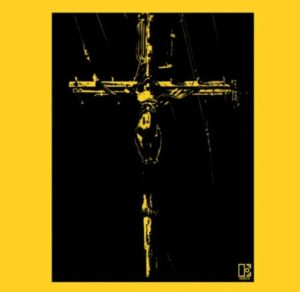
Telephone pole crucifixion and the Doors also somehow part of this story.
(The official book launch will be on September 27th at 1933 Juniper St. in Longmont, CO, from 5:30 till sundown, with convivial companionship, refreshment, and a reading by the poet from I’ll Begin in the Middle, with copies available for purchase. Open to everyone!)
Between that one thing and the other thing…
FALLS THE SHADOW
(Adding a little TS Elliot, in case he didn’t already make it into the mix)
He’s one of the ghosts you can’t see.