
#10 KEROUAC’S HAIKU—Part Three: The Flowers Don’t Seem to Mind
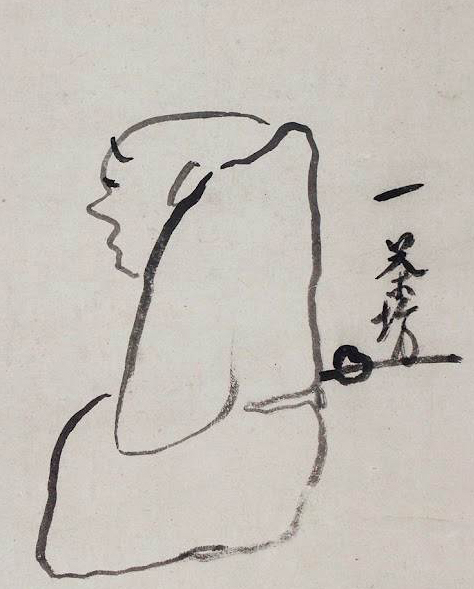
Issa, self-portrait
There’s much to appreciate in Kerouac’s haiku descriptions of human emotions and humanity:
Her yellow dolls bowing
on the shelf—
My dead step grandmother
The artifacts of the person now dead stand in that person’s place, and continue to articulate who she was. Are they bowing to her? I rather think they’re sagging from her absence.
Perfect moonlit night
marred
By family squabbles
This sums up what a lot of human preoccupation amounts to. It pays no heed to the perfect world, only to its own insatiable dramas. “Perfect moonlit night” stretches the vowel sound spaciously, while “By family squabbles” scrunches the consonants together. The expansive, spacious background surrounding claustrophobic human argument—done in 12 syllables.
Old man dying in a room—
Groan
At five o’clock
It seems almost senseless to comment on this. It somehow says everything. “Groan/At five o’clock” makes the moment concrete, particular, definitive. Another, similar haiku expresses more of the larger world, the surrounding space:
Man dying—
Harbor lights
On still water
The harbor lights imply the surrounding night. The “still water” adds to the quietude, to the largeness and depth of space. It’s poignant that the scene will remain even if the man dies, leaving it. Kerouac caught this one in even fewer syllables.
The scene here remains only as a memory of warm good times:
Big drinking & piano
parties—Christmas
Come and gone—
He creates the presence of Christmas parties to describe the feeling of their absence.
Here the internal, human emotional state contrasts hilariously with the uncooperative external world:
The flowers don’t seem
to mind
the stupid May sunshine
That internal grousing overwhelms this haiku:
Wednesday blah
blah blah—
My mind hurts.
Sickened by fact of his habitual discursive thoughts. Any meditator will sympathize. Again, he gets at a lot with extraordinary concision. On the other hand:
Desk cluttered
with mail—
My mind is quiet.
The thoughts are there in the form of mail, but the mind doesn’t buy in.
He also captures the poignant pain of human interaction. Here he gets his mileage from what isn’t said, with the concrete particulars wholly absent, while landing on the inner constriction out of determined integrity or possibly the pure helplessness that you can’t make yourself understood:
Why explain?
bear burdens
In silence
It describes the felt isolation provoked by human interaction, as does this one:
The son who wants solitude,
Enveloped
In his room
The room becomes both the son’s mind and a boundary against (familial?) engagement.
Then again, in this one, family becomes fully present through a very simple moment of connection:
Four in morning—
creak my mother
In her bed
The broken syntax here resonates with a half-asleep kind of perception available at the quietest moment of the night. Putting “creak my mother” into one line firmly identifies the mother and the creak as one thing. This particular creak resonates with this mother and the many shades of unspoken feeling that might have late at night.
A couple of poignant, self-revealing haiku revolve around sexual relationships:
At night
The girl I denied
Walking away
You can’t avoid the sadness of that one, even if his decision was perfectly justified for whatever reason. He nevertheless notices the sadness of it (notice what you notice!), enough to articulate it. In this one, the self-recrimination is more overt:
Windows rattling
in the wind
I’m a lousy lover
In the first, the image of loss comes through watching her recede into the darkness; in the second, the wind and the windows do the job. Again, for all the volumes and volumes of discursive thought that could surround this painful, confessional self-perception, he delivers it in four words: “I’m a lousy lover.” In haiku, maybe more than in any other literary form, the unsaid gets the most weight.
Here is simple tenderness:
The son packs
Quietly as the
Mother sleeps
And here he makes a grander gesture of affection:
Hitchhiked a thousand
miles and brought
You wine
The enjambment makes it into more of a single sentence statement, one fulsome sweep: “Hitchhiked a thousand miles and brought you wine.” Suddenly the bottle’s infused with the long journey to bring it, and all the more wonderful to drink.
The fly, just as
lonesome as I am
In this empty house
You could certainly accuse Kerouac of projecting his human feelings on the fly, but he is at any rate feeling the smallness of the fly in the huge space delineated by the house around it, like his own solitary smallness in the universe. There’s a sympathetic vibe that marks his gentle regard for the vulnerability of sentient beings. It’s obviously not just wordcraft that makes a poet—it’s the poet’s being, a being that can live on in a suggestion, in three lines and a few syllables.
gorgeous choices, Gary, thx. anytime u want to xchange haiku training for ohana (ikebana) class(private, semiprivate, workshops available avail in 2923, starting up again in mid january…
You’re welcome. Let me think about it.